
Six months ago, this brand’s email program was a single monthly newsletter sent to the entire list. No flows, no segmentation, no plan for what happened after someone bought their first tub of protein.
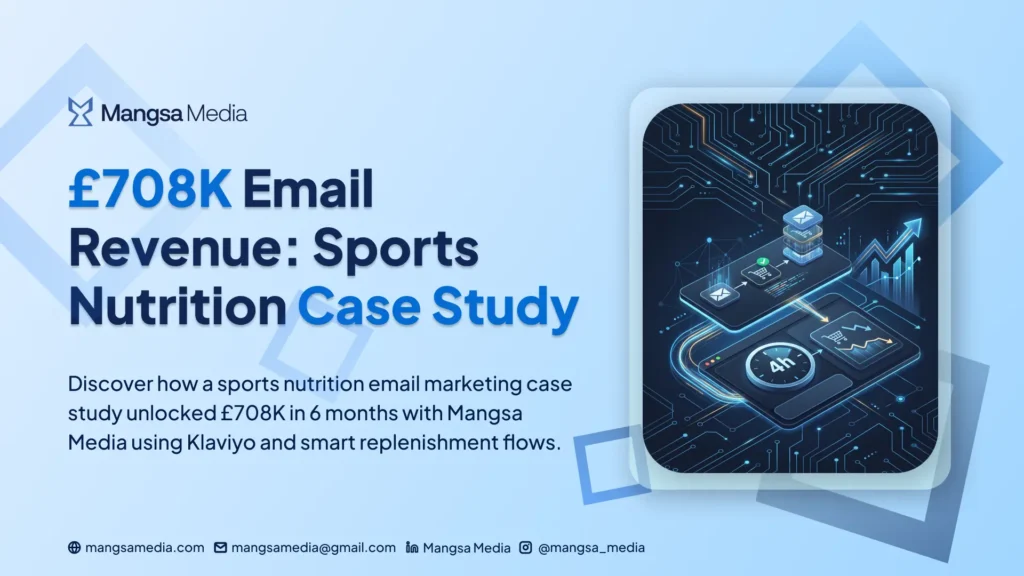
Today it generates £708,561 in attributed revenue, and more than half of that comes from automation running quietly in the background. Here’s the full sports nutrition email marketing case study: what changed, and why it worked.
Most e-commerce founders running brands between $10k and $100k per month attempt to handle retention internally until performance hits a wall. Across Klaviyo’s benchmark data, automated flows generate roughly 41% of total email revenue from only 5.3% of sends, an outsized return for a small share of total volume (Eightx, 2026). Relying on basic blasts leaves money on the table while your ad spend burns out.
Building dynamic behavior-driven sequences reverses this trend. By auditing product consumption cycles and customer journeys before building flows, you can convert one-off buyers into loyal repeat customers without relying on heavy discounts.
Why Scaling Ad Spend Burned Margin Before the Audit
Acquiring new fitness enthusiasts through paid social ads built initial top-of-funnel momentum, but rising acquisition costs quickly ate into profit. Driving traffic without automated post-purchase systems meant most first-time customers vanished after their initial tub of protein.
According to online e-commerce research, average cart abandonment across retail sites sits at 70.22% (Baymard Institute, 2026). Spending ad capital to acquire site visits without a proper retention engine means running a store with major backend leaks.
When we audited the brand’s customer journey, their existing email setup relied almost entirely on manual promotional newsletters sent to the entire list.
There was no replenishment strategy, no re-engagement path for lapsed buyers, and no consistent campaign schedule- exactly the gaps most growing supplement brands hit once they outgrow a founder sending emails between everything else.
Our diagnostic methodology focuses on business health first and marketing channels second. Before setting up new flows, we evaluate actual margins, product consumption rates, and customer touchpoints to locate exact revenue drains.
Related reading: 15-Point Klaviyo Retention Audit Checklist (2026)
Rebuilding Lifecycle Flows for Supplement Brand Email Marketing
Plugging customer leaks required replacing generic broadcasts with dynamic lifecycle branches tailored to supplement buyers. Instead of blasting site-wide discounts, we built behavioral automated paths that educated buyers, improved product usage habits, and prompted timely reorders.
1. Educational Post-Purchase Onboarding
New customers rarely reorder supplements if they do not build a daily habit or understand proper product usage. Establishing clear usage guidance during the first two weeks reduces buyer remorse and increases long-term brand trust.
We introduced plain-text onboarding emails sent directly from the brand founder. These messages covered mixing ratios, ideal daily intake timing, and what to expect from consistent use, helping customers get real value from their first order instead of letting the tub sit half-used in a cupboard.
2. Consumption-Based Replenishment Flow
Standard 30-day reorder emails fail once product sizes vary, a 15-day trial size and a 60-day bulk tub don’t run out on the same schedule. Sending a reorder reminder at the wrong time either annoys the customer or lets them run out and order from someone else instead.
We built the replenishment flow around actual product usage cycles instead of a single fixed delay. This was one part of a wider lifecycle rebuild, alongside segmentation and win-back, that together drove the revenue results below.
3. Plain-Text Abandonment and VIP Nurturing
High-intent shoppers abandoning checkout do not need glossy banners that look like corporate promotions. Simple, conversational text notes build a direct personal connection while removing buying friction.
We replaced heavy visual templates with direct plain-text nudges addressing shipping questions and ingredient details. This mirrors what broader research on triggered, personalized emails has found too, messages built around real behavior consistently outperform generic sends (Nobile & Cantoni, 2023).
The Results
Six months after rebuilding the brand’s email and SMS retention system, attributed email revenue reached £708,561.19, making up 21.52% of the brand’s total revenue over that period.
Of that, £399,830.67 (56.43%) came from automated flows and £308,730.53 (43.57%) came from planned campaigns, a healthier split than the campaign-only setup the brand started with.
| Metric | Result |
| Total attributed email revenue | £708,561.19 |
| Share of total store revenue | 21.52% |
| Revenue per recipient | £0.12 |
| Revenue from automated flows | £399,830.67 (56.43%) |
| Revenue from campaigns | £308,730.53 (43.57%) |
The flow-heavy split matters here. A brand still running email as batch-and-blast newsletters typically pulls most of its revenue from campaigns alone, with flows contributing very little in the background.
Getting flows past the halfway mark is usually a sign the lifecycle system is doing the quiet, compounding work it’s supposed to.
Key Lessons from This Sports Nutrition Email Marketing Case Study
Scaling a consumable brand past $10k to $100k per month requires treating email and SMS as reliable repeat order systems. When paid customer acquisition costs jump on Meta and TikTok, having automated retention flows keeps cash flow steady.
Founders can apply several immediate operational improvements based on these retention results:
- Map Delays to Product Sizing: Match reorder emails to actual consumption timelines rather than using generic monthly timers.
- Prioritize Plain-Text Copy: Write conversational notes that look like direct personal messages to stay out of the Promotions tab.
- Educate Before Pitching: Help buyers build product usage habits during the first 14 days before asking for a second sale.
- Segment by Buying Behavior: Separate first-time buyers, repeat VIPs, and unengaged contacts to protect sender domain authority.
Related reading: The Best 5 Email Marketing Agencies for DTC Brands in 2026
Diagnosing Your Customer Journey Before Scaling
Spotting backend leaks early allows you to recover paid acquisition spend and build a profitable e-commerce business. Before spending time designing complex visual templates or testing discount codes, evaluate where your store loses repeat buyers.
Don’t fix your email flows until you know what’s actually broken in your customer journey. Running a comprehensive retention diagnostic helps identify weak timing delays, poor deliverability, and missed reorder opportunities. Addressing these exact friction points ensures your email marketing drives long-term customer growth.
Common Questions About Sports Nutrition Email Marketing Case Study
How did this brand grow email revenue to £708,561 in six months?
By replacing a single monthly newsletter with a full lifecycle system, replenishment flows, plain-text abandonment, and VIP nurturing, built around actual product usage cycles.
Why did a standard 30-day reorder email fail for this brand?
Product sizes varied, so a fixed reminder either came too early or let customers run out and reorder elsewhere.
How much of the revenue came from flows versus campaigns?
56.43% (£399,830.67) came from flows and 43.57% (£308,730.53) from campaigns, a healthier split than the brand’s original newsletter-only setup.
Why did plain-text emails outperform visual templates here?
Simple, conversational notes built a more direct connection with high-intent shoppers than glossy, corporate-looking banners.
What’s the first thing to fix before scaling ad spend on a consumable brand?
Match reorder timing to real product usage and educate buyers in the first 14 days before pitching a second sale.
References
- Baymard Institute. (2026). 48 Cart abandonment rate statistics 2026.
- Eightx. (2026). Klaviyo flow revenue benchmarks by brand stage.
- Nobile, T. H., & Cantoni, L. (2023). Personalisation (in)effectiveness in email marketing. Digital Business, 3(2), 100058.