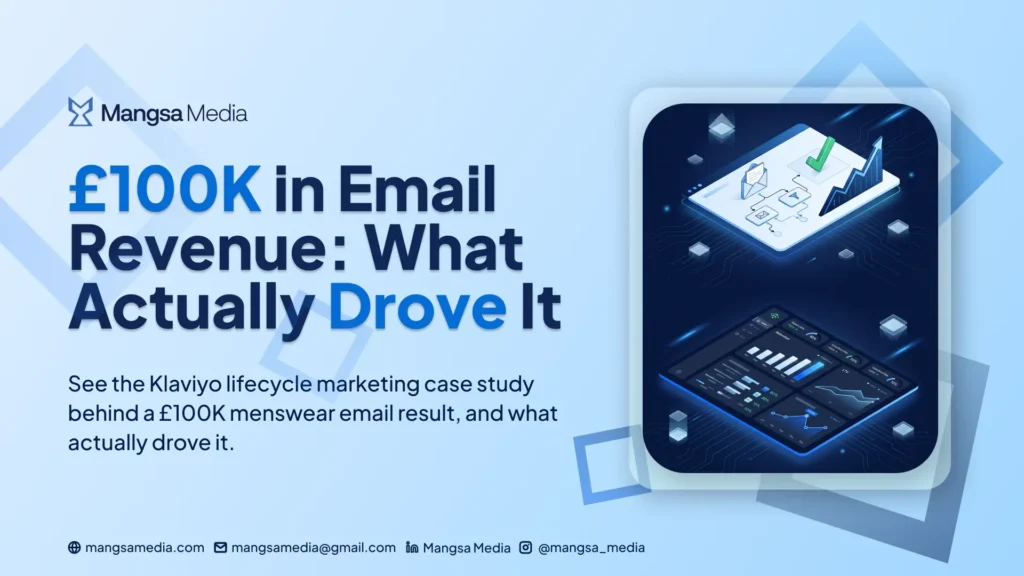

Most Klaviyo lifecycle marketing case studies stop at one headline number and skip the part that actually explains where the money came from. A British menswear brand pulled £100,606.83 in attributed email revenue, 39.01% of total store revenue, after fixing a lifecycle setup that had been quietly leaking money for months. The total isn’t the interesting part. Where that money actually came from is.
Inside the Klaviyo Lifecycle Marketing Case Study Numbers
Before getting into what changed, it helps to see exactly how the revenue split. This is the kind of breakdown most brands never look at because they’re too focused on the top-line total.
| Metric | Result |
| Total attributed email revenue | £100,606.83 |
| Share of total store revenue | 39.01% |
| Revenue per recipient | £0.09 |
| Revenue from campaigns | £40,788.75 (40.54%) |
| Revenue from automated flows | £59,818.08 (59.46%) |
Notice that automated flows outpulled one-off campaigns by almost 20 percentage points. That’s not an accident.
It’s what happens when the emails a customer receives are tied to what they actually did on the site, not just the day of the week your calendar said “send newsletter.”
The Actual Problem Before Anyone Touched Klaviyo
This brand wasn’t struggling to get people in the door. Their product quality was solid and first-time purchases weren’t the issue.
The trouble started right after checkout. Customer engagement dropped off hard after the first purchase, personalization across different customer groups was thin, and the automations already running weren’t built to catch the revenue sitting right in front of them.
Four things stood out during the diagnosis:
- A low repeat purchase rate despite genuinely good products
- Customer engagement that fell off a cliff after the first sale
- Limited personalization across different customer segments
- Existing automations that weren’t optimized to capture available revenue
This pattern shows up constantly in apparel. A 2021 academic study on personalized services in apparel e-commerce found that customer satisfaction and retention specifically depend on how a brand handles the post-purchase phase, not just the buying moment itself (Jain & Sundström, 2021).
Get someone to buy once and stop paying attention right after, and you’ve built a business that has to keep buying new customers to replace the ones it just lost.
What Actually Changed: Lifecycle Strategy Over Guesswork
Fixing this didn’t start with picking flows off a template list. It started with mapping out where this specific customer journey was breaking down, then building the lifecycle strategy and segmentation around that map. The rebuild covered a few core pieces working together.
1. Welcome series and browse abandonment. New subscribers and browsers got messaging based on what they’d actually looked at, not a generic “welcome to the family” blast.
2. Abandoned cart and post-purchase automation. This is where the account started capturing revenue it had been missing outright, and it’s also the biggest reason flows ended up outperforming campaigns.
3. Behavior-based segmentation. Instead of one list getting one message, customers were split by what they’d bought, browsed, or ignored.
4. Consistent promotional and storytelling campaigns. Campaigns still mattered. They just got smarter targeting instead of a blanket send.
The segmentation piece is worth pausing on. Klaviyo’s own benchmark data on fashion and apparel brands found that highly segmented campaigns generated close to three times the revenue per recipient of unsegmented sends, with the top-performing segments built around specific customer behavior rather than broad demographic guesses (Klaviyo, 2023).
That lines up almost exactly with what this brand’s own Klaviyo segmentation results show. The campaigns that worked were the ones built around behavior, not the ones sent to “everyone.”
This also matches what McKinsey found when it looked at companies that grow faster than their competitors. Faster-growing brands pull 40% more of their revenue from personalization than slower-growing ones do, and that gap tends to widen the longer a brand waits to close it (McKinsey, 2021).
Related reading: Klaviyo Abandoned Cart Flow Timing: Stop Default Delays
Why Flows Beat Campaigns By Almost 20 Points
Automated flows brought in £59,818.08 against £40,788.75 from campaigns. That’s not a small gap, and it’s not unusual once a lifecycle is actually built correctly.
Pull up almost any email automation case study worth reading, and you’ll find the same pattern underneath it. Flows work because they’re triggered by something real.
Someone abandoned a cart. Someone bought and went quiet. Someone browsed a product three times and didn’t pull the trigger. Each of those moments carries more buying intent than a scheduled Tuesday newsletter ever will, because the customer already told you what they care about through their own behavior.
Campaigns still earned their 40% share here, and that matters too. A lifecycle system that only runs on autopilot flows and never talks to customers directly through campaigns leaves relationship-building and storytelling on the table. The win wasn’t picking flows over campaigns. It was making both of them behavior-driven instead of generic.
What This Means If You’re Running a DTC Apparel Brand
If your ad spend on Meta or Google is doing its job but your repeat purchase rate looks flat, this is usually where the problem lives. Not in your acquisition channels. In what happens to a customer the moment after they buy.
This is exactly the gap most apparel brand email marketing setups have. You’re paying to bring someone in through ads, they buy once, and then the emails they get afterward look nothing like what actually got them to purchase in the first place. That’s money you already spent to acquire the customer, walking straight back out the door.
Mangsa Media works with DTC and e-commerce brands as a retention marketing agency built specifically around Klaviyo email and SMS. The approach behind results like this one starts the same way every time.
Business problem first, channel second. That means auditing the actual customer journey, where engagement drops, where segmentation is thin, before touching a single flow.
A brand doing $10k to $100k a month rarely needs more traffic. It usually needs a system that turns the traffic it’s already paying for into customers who come back.
Related reading: 5 Signs You Need to Hire an Email Marketing Agency (Instead of DIY)
Don’t rebuild your flows until you know exactly what’s broken in the journey first. A £100K result like this one didn’t come from better templates. It came from a proper diagnosis of where the money was actually leaking, then a lifecycle built to plug it. Book a free retention health check now.
References
- Jain, S., & Sundström, M. (2021). Toward a conceptualization of personalized services in apparel e-commerce fulfillment. Research Journal of Textile and Apparel, 25(4), 414–430.
- Klaviyo. (2023). Email segmentation benchmark report.
- McKinsey & Company. (2021). The value of getting personalization right, or wrong, is multiplying.