
Most founders don’t have a flow problem. They have a “nobody’s ever actually looked at this account” problem. A proper Klaviyo retention audit checklist isn’t about adding more flows or writing better subject lines. It’s about finding the specific place your customer journey is leaking money, before you spend another dollar guessing.
If you’re doing $10k to $100k a month and you set your Klaviyo account up once, back when you launched, and haven’t touched the core structure since, this checklist is for you. Grab your dashboard and go through it point by point.
What a Real Klaviyo Account Audit Actually Checks
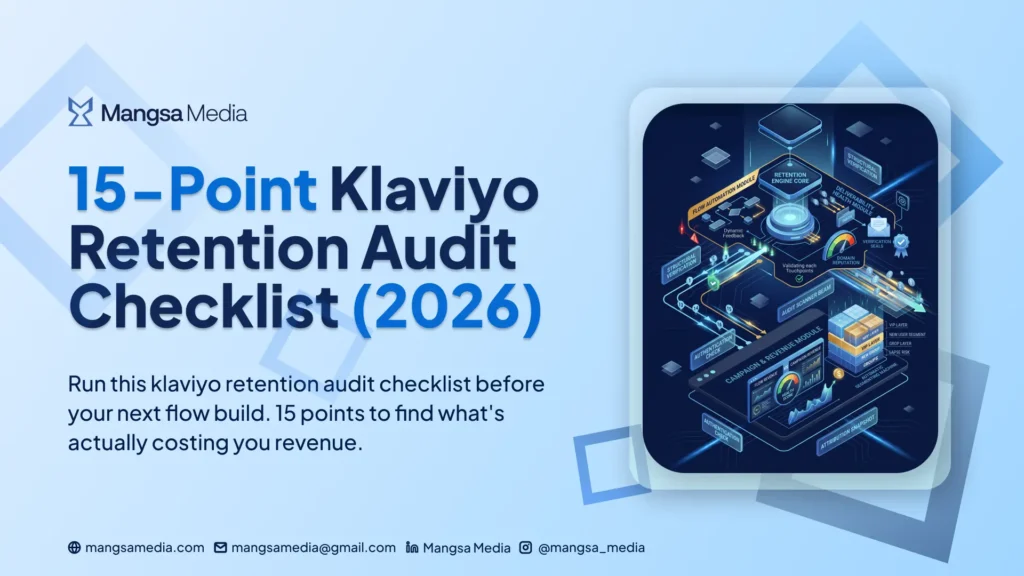
A Klaviyo account audit isn’t one long list of vanity metrics. It breaks into four areas that actually drive revenue. Your automated flows come first, then your deliverability health, then your list and segmentation, and finally how your campaigns and flows split the work between them.
Each area exposes a different kind of leak. Flows catch behavior your account should already be reacting to. Deliverability determines whether any of that reaction ever reaches an inbox in the first place.
List health decides whether the people receiving your emails are even worth messaging. And the campaign versus flow split tells you which channel is actually earning its keep, instead of which one you assume is.
Go through each section in order. Skipping ahead to “fix the flows” before checking deliverability is how founders end up rebuilding a welcome series that was never going to land in the inbox anyway, because the domain reputation underneath it was already damaged.
Flow Automation Audit
Your flows run while you sleep, so a broken one quietly costs you money every single day it stays broken. Start here, one flow at a time.
1. Welcome Series Is Live and Has at Least Three Emails
A single “thanks for signing up” email leaves real money on the table compared to a proper series that builds trust first. New subscribers rarely buy on day one, so a three-plus email series that introduces the brand, handles objections, and only then makes an offer converts more of them than one generic email ever will.
2. Abandoned Cart Flow Triggers Within One Hour
Waiting a full day to follow up on a cart means you’re chasing intent that’s already cooled off. The person who almost bought something is far easier to bring back in the first sixty minutes than the next morning, once the moment and the mood that drove the click have already passed.
Related reading: Klaviyo Abandoned Cart Flow Timing: Stop Default Delays
3. Browse Abandonment Runs as Its Own Flow
Browsing and abandoning a cart are two different behaviors, and they deserve two different messages instead of one flow trying to cover both. Someone who looked at three products and left hasn’t shown the same intent as someone who added an item to their cart, so treating the two the same way wastes the more urgent trigger on a softer audience.
4. Post-Purchase Flow Goes Beyond a Shipping Confirmation
This is where you set expectations, reduce refund requests, and start building toward the next order. A good post-purchase flow answers the questions a customer hasn’t asked yet, like how to use the product properly, well before they’d think to open a support ticket.
5. Win-Back Flow Matches Your Actual Purchase Cycle
A skincare buyer and a furniture buyer don’t lapse on the same timeline, and treating them the same wastes the flow entirely. Building win-back triggers around a flat 90-day rule instead of the product’s real replenishment cycle means you’re either reaching out too early, while stock is still full, or too late, once the customer has already bought the same thing somewhere else.
Deliverability Audit
None of the flows above matter if your emails are landing in spam. A deliverability audit checks the plumbing before anyone touches the copy, and it’s the section founders skip most often because it doesn’t feel like “real” marketing work.
That’s exactly why it belongs first, not last. A brilliant subject line sent from a domain with a damaged reputation still lands in Promotions or Spam, no matter how good the copy underneath it is.
6. Domain Authentication Is Fully Set Up
SPF, DKIM, and DMARC all need to be configured correctly, not just “mostly working.” Gmail’s official sender guidelines require both SPF and DKIM authentication for anyone sending meaningful volume, plus a published DMARC record, and missing even one of the three is enough to get messages rate-limited or rejected outright [1].
7. Sunset Flow Is Active for Unengaged Profiles
Continuing to mail people who haven’t opened anything in 90 or more days drags your whole domain reputation down. A sunset flow gives those profiles one last chance to re-engage and then quietly removes them from regular sends, protecting the inbox placement of the emails going to people who actually want them.
8. Open Rate Sits in a Healthy Range for Your Industry
Klaviyo’s 2026 benchmark data, drawn from over 183,000 brand accounts, shows automated flows earning a meaningfully higher share of email revenue than campaigns do relative to how often they’re sent, which only happens when flow open rates are genuinely strong [2]. If your flows are underperforming your own campaigns on open rate, something structural is off, not just your subject lines.
9. Bounce Rate Stays Under Two Percent
Anything higher usually means your list has stale or invalid addresses that need cleaning out. A bounce rate creeping past that line is also one of the clearest early warnings that your next campaign is about to land in spam, well before your open rate shows any obvious damage.
List and Segmentation Health
A flow automation audit means nothing if the list underneath it is a mess. This is where most DIY setups fall apart quietly, because a messy list doesn’t show up as an error anywhere. It just shows up as flat revenue month after month, with no obvious cause.
10. List Is Segmented Beyond “Everyone”
If your only segments are subscribers and non-subscribers, you’re running one program for buyers at completely different stages. A first-time visitor, a repeat customer, and someone who hasn’t purchased in six months all need a different message, and lumping them together means most of your list is getting content that isn’t actually for them.
11. VIP or High-LTV Segment Gets Different Treatment
Your best customers shouldn’t see the same generic 10% off code as a brand new visitor. Giving your highest-spending customers earlier access, better perks, or simply less discounting protects your margins while still making them feel recognized for what they actually spend.
12. Replenishment Segments Match Actual Usage Cycles
Guessing at a replenishment window once and leaving it alone is how these segments quietly go stale. A product that actually runs out every 45 days but gets flagged for a 60-day reminder means you’re reaching customers after they’ve already reordered somewhere else, or forgotten about you entirely.
Campaign and Revenue Attribution
The last piece is understanding where your revenue is actually coming from, not where you assume it’s coming from.
13. Campaign and Flow Revenue Are Tracked Separately
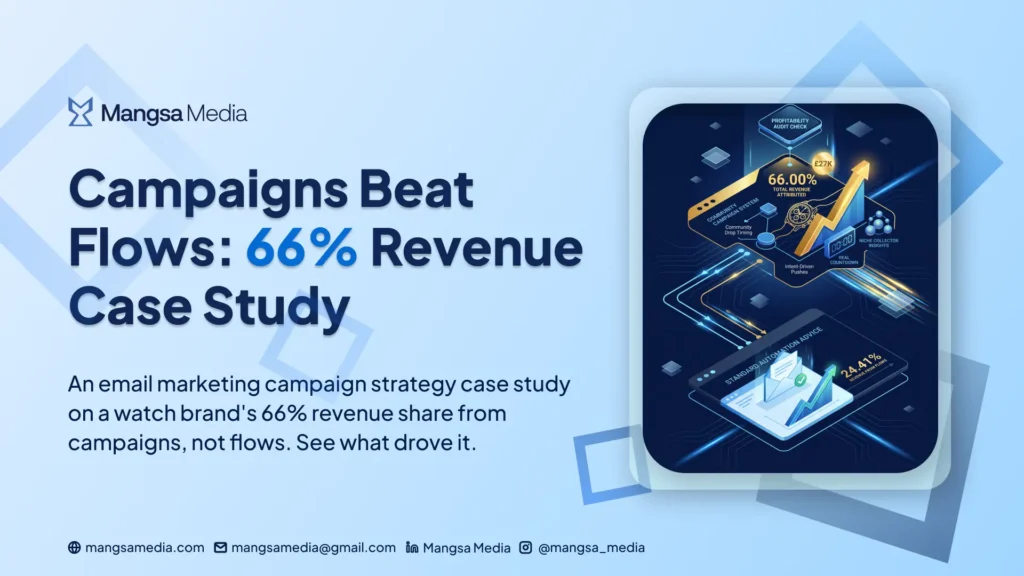
Lumping everything into one “email revenue” number hides which channel is actually doing the work. A vintage watch competition platform we worked with generated 66% of its total business revenue through email, and three quarters of that came from campaigns rather than flows, a split that only became visible once the two were measured apart from each other.
Case study: Vintage Watch Competition Platform: 66% of Revenue from Email
14. Revenue Per Recipient Is Tracked by Segment
An account-wide average hides which segments are actually working and which are dead weight. A VIP segment and a cold re-engagement segment can sit on completely different ends of the revenue-per-recipient scale, and averaging them together makes a strong segment look mediocre while a weak one hides in plain sight.
15. You Know Your Klaviyo Health Score and What’s Driving It
A score without the underlying breakdown tells you something’s wrong without telling you what to fix. Knowing that your score dropped is close to useless on its own, but knowing it dropped because of a spike in spam complaints, rather than a slow list, points you straight at the actual problem.
What Your Klaviyo Health Score Actually Means
A single health score is a starting point, not a diagnosis. Two accounts can land on the same score for completely different reasons, one from weak flows and the other from a messy list, and the fix for each is nothing alike.
That’s the part most self-service audit tools miss. They’ll tell you your score dropped without telling you whether the fix is a new flow, a list cleanup, or a shift in how much weight your campaigns are carrying. A number without a cause just gives you something to worry about, not something to act on.
Read next: Klaviyo Abandoned Cart Flow Timing, Stop Default Delays
Run through this checklist honestly, point by point, and you’ll walk away with more than a score. You’ll know exactly which of the four areas is dragging the rest down, and that’s the difference between guessing at your next Klaviyo project and actually fixing the thing that’s costing you revenue.
Don’t fix your email flows until you know what’s actually broken in your customer journey. If you’ve gone through all 15 points above and you’re still not sure where the real leak is, book a free Retention Health Check with Mangsa Media and get a second set of eyes on the account before you touch another automation.
References
- Google. (2026). Email sender guidelines FAQ. Gmail Help.
- Klaviyo. (2026). 2026 email marketing benchmarks by industry. Klaviyo Email Marketing Benchmarks.