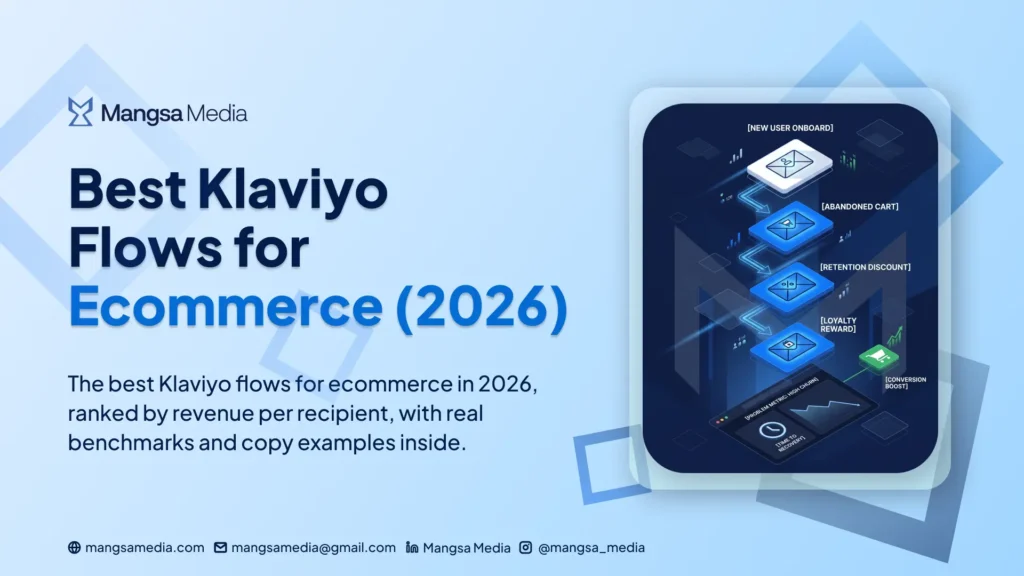

Most stores build two flows, call it done, and wonder why email stalls at 10% of revenue. The best Klaviyo flows for ecommerce aren’t complicated, they’re just incomplete in nearly every account we open. A founder sets up Welcome and Abandoned Cart during onboarding, gets a quick lift, and stops there.
Brands treating email as a full system pull close to 41% of total email revenue from flows most stores never touch, despite those flows making up a sliver of total sends (Eightx, 2026). The gap isn’t effort, it’s which flows exist and which one gets ignored because it “feels done already.”
If you can only build three this month, build Started Checkout Recovery, Welcome Series, and Back-in-Stock. Those three carry the highest revenue per recipient of the ten below, and all three can be turned on from Klaviyo’s pre-built templates without custom development.
Group Your Flows by Customer Stage, Not by Feature List
Before building anything, think in stages instead of a flat list of automations. A new subscriber, a cart abandoner, and a customer who bought six months ago all need a different message, and lumping them together is how brands end up with generic, low-performing sequences.
We audit accounts across six stages, moving from First Contact through Abandonment Recovery, Post-Purchase, Retention, Loyalty, and Re-Engagement. Every one of the essential Klaviyo automations below sits in one of these stages, and the build order matters more than most founders assume.
The 10 Best Klaviyo Flows for Ecommerce Brands to Build Right Now
Some of these get treated as optional. They’re not, and the data below explains why each one earns its spot on this Klaviyo flows list.
1. Welcome Series
This is your highest-volume touchpoint and one of the stronger revenue-per-recipient flows in the account (Eightx, 2026). A single welcome email is the most common mistake we see. Three emails, spaced over the first week, consistently outperform one.
A subject line that works better than “Welcome to [Brand]” is something closer to a real question, “Quick one before you start shopping” or “The thing most new customers miss.” Plain, low-pressure, no exclamation point doing the heavy lifting. Next comes the three abandonment flows, each built for a different level of intent.
2. Started Checkout Recovery
Klaviyo separates “Checkout Started” from “Added to Cart” as two distinct triggers, and treating them as one flow leaves money on the table. Checkout Started fires once someone has entered contact details at checkout, a much higher intent signal than simply adding a product.
Cart abandonment across ecommerce sits at roughly 70.22% of sessions, a number the Baymard Institute has tracked across dozens of studies for years (Baymard Institute, 2026).
Recovering even a fraction of that at checkout stage is the single highest-RPR flow in most Klaviyo accounts, averaging $3.65 per recipient with top performers reaching $28.89 (Klaviyo, 2024).
Most of the leak here isn’t the flow’s existence, it’s the default timing. Out of the box, Klaviyo waits four hours before the first email, long enough for high-intent buyers to cool off or buy elsewhere.
Related reading: Klaviyo Abandoned Cart Flow Timing: Stop Default Delays
3. Added to Cart Recovery
Someone added a product but never reached checkout, so intent is lower, and the tone should be lighter, closer to a reminder than a recovery pitch.
A three-email sequence (nudge, social proof, small incentive) beats a single “you left something” email by a wide margin.
4. Browse Abandonment
This is the most underbuilt flow in the average account. It converts lower than cart flows, averaging around $1.07 per recipient (Eightx, 2026), but it’s also the earliest point you can catch someone before they leave without any commitment at all.
Peer-reviewed research on triggered emails backs this up, directly showing that personalized, triggered messages measurably lift purchase intent and revenue compared to generic sends (Nobile & Cantoni, 2023).
Keep it light here. One email two to four hours after the view, product-focused, no discount yet. Once someone actually buys, the job shifts to what happens after the sale.
5. Post-Purchase / Transactional
Order confirmations and shipping updates get opened at a much higher rate than any marketing send, and most brands waste that attention on a bare receipt.
Layering in usage tips, unboxing guidance, or a soft cross-sell here costs nothing extra to build and compounds over every single order.
Post-purchase is rarely just one email either. It usually works better as a short sequence, confirmation first, then care or usage tips, then a review request days later, rather than one message trying to do all three jobs at once.
6. Back-in-Stock
This is the highest revenue-per-recipient flow of the ten, averaging $9.14 per recipient (Eightx, 2026), and it’s also one of the easiest to overlook because it only fires for people who already asked to be notified.
That’s the point. Nobody signs up for a back-in-stock alert casually, so the intent behind every send is already close to a decision.
Keep the message short. Confirm the item is back, link straight to it, and skip the discount unless you’re clearing aged stock.
Anything more gets in the way of someone who’s already decided to buy. From here, the focus moves to keeping customers buying.
7. Replenishment
For consumable products, this flow runs on the customer’s actual usage cycle instead of a generic 30-day timer.
A supplement or sports nutrition brand sees a very different reorder window than a skincare brand, and getting that timing wrong is the most common reason replenishment flows underperform.
Our own work with a UK sports nutrition brand included building this exact flow as part of a wider lifecycle overhaul, one piece of a system that grew attributed email revenue to £708,561 over six months. You can read the full case study here.
8. Win-Back / Re-Engagement
Win-back averages $0.84 per recipient (Eightx, 2026), the lowest of the core flows, but that number mostly reflects how badly most brands write it.
A gift or seasonal-gifting brand needs a different win-back cadence than one with a short repurchase cycle, something we saw directly while rebuilding this flow for a UK gift hamper and chocolate brand. “It’s been a while, here’s what’s new” beats a blanket discount code almost every time.
9. VIP / Loyalty
Reserve this for your top percentile of spenders, not your whole list. Early access, exclusive drops, and recognition (not just discounts) protect margin while still making high-LTV customers feel seen.
10. Sunset Flow
The most skipped flow on this list, and arguably the most protective one. A properly built sunset sequence recovers a meaningful share of dormant profiles before suppressing the rest, and those who do re-engage tend to carry above-average lifetime value. Skip this flow and your whole domain’s sender reputation pays for it.
Stop Trusting Open Rate to Tell You Any of This Worked
Apple’s Mail Privacy Protection now accounts for roughly half of all opens tracked in Klaviyo, and it pre-loads tracking pixels whether or not a human ever reads the email (Geysera, 2026). Your open rate dashboard has been quietly lying to you since 2021.
Revenue per recipient is the metric that actually tells you whether a flow works, not opens. If you’re still optimizing subject lines by open rate alone, you’re optimizing for a number that stopped meaning much once MPP rolled out.
Here’s how the ten flows above stack up on revenue per recipient, using the same benchmark data referenced throughout this Klaviyo flow checklist for ecommerce:
| Flow | Avg. RPR | Notes |
| Back-in-stock | $9.14 | Highest intent trigger in Klaviyo |
| Started Checkout | $3.65 | Top 10% reach $28.89 |
| Welcome Series | $2.65 | Best with 3+ emails |
| Browse Abandonment | $1.07 | Most underbuilt flow |
| Win-Back | $0.84 | Lowest, but most misused |
(Source: Eightx, 2026, compiling Klaviyo benchmark data)
Building the List Isn’t the Hard Part
Any single flow on this list can be turned on in an afternoon. Getting the trigger timing, segmentation, and plain-text tone right for your product and price point is a different job, and it’s usually where a default setup quietly leaks revenue.
That usually means moving past a generic template into a custom Klaviyo architecture built around how your customers actually buy.
Choosing plain-text over fancier HTML, so recovery emails land in the primary inbox rather than Promotions, is its own decision worth getting right first. Post-purchase, in particular, is rarely just one email. It’s a sequence with its own logic.
If you’re not sure which of these ten is actually broken versus which just needs a small tweak, that’s a diagnostic question before it’s a build question.
Don’t rebuild your flows until you know what’s actually leaking, which is usually the point where a small DTC brand decides it’s time to bring in outside help instead of patching things alone.
References
- Baymard Institute. (2026). 48 Cart abandonment rate statistics 2026.
- Eightx. (2026). Klaviyo flow revenue benchmarks by brand stage.
- Geysera. (2026). Are email open rates dead in 2026? What Apple MPP, Gmail proxy, and bot opens mean for your data.
- Klaviyo. (2024). Abandoned cart benchmark report: Rates and statistics.
- Nobile, T. H., & Cantoni, L. (2023). Personalisation (in)effectiveness in email marketing. Digital Business, 3(2), 100058.