
Every email marketing campaign strategy case study you’ll find online tells you the same thing. Build your flows first, treat campaigns as an afterthought, let automation carry the weight.
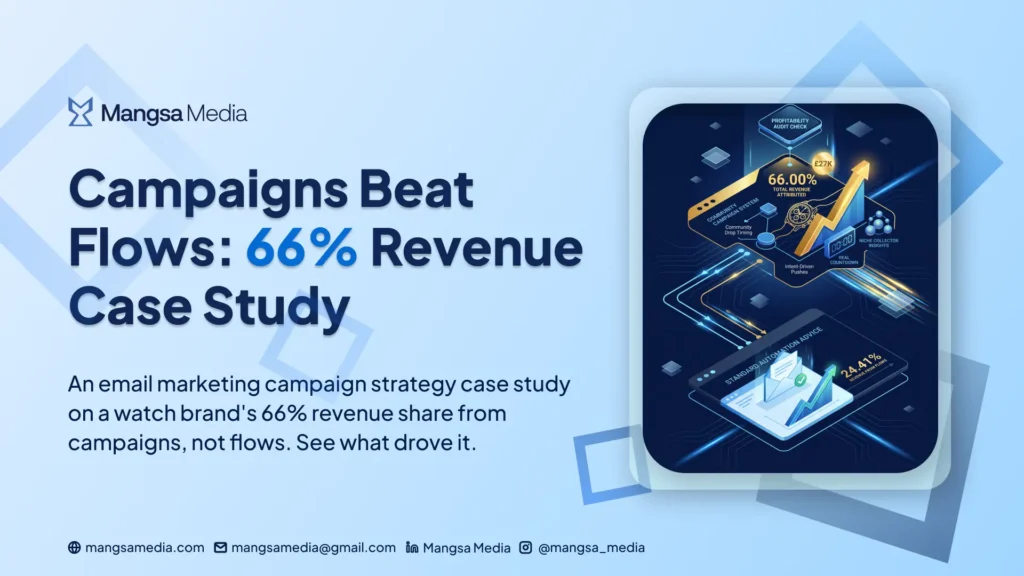
A UK vintage watch competition platform didn’t follow that script. It generated £27,438.75 in attributed email revenue, which worked out to 66% of the business’s total revenue for the period. Most of that came from manual campaigns, not automated flows.
That’s the opposite of what most retention advice tells you to expect. It’s exactly why this case is worth breaking down.
The Numbers Behind a 66% Email Revenue Share
The platform runs limited-entry prize draws for vintage and luxury watches. Collectors enter, wait for the draw, and (hopefully) come back for the next one.
Before working with Mangsa Media, the brand faced a familiar set of problems. New entrants didn’t trust the platform enough to commit. Subscribers went quiet between competition launches.
There was no real urgency mechanism to push people toward closing entries. Repeat participation was inconsistent at best.
The retention build focused on customer lifecycle strategy, audience segmentation, a welcome series to build trust with first-time entrants, and countdown campaigns timed around each draw closing. Here’s what that produced.
| Metric | Result |
| Total attributed email revenue | £27,438.75 |
| Share of total business revenue | 66.00% |
| Revenue per recipient | £0.26 |
| Revenue from campaigns | £20,739.75 (75.59%) |
| Revenue from automated flows | £6,699.00 (24.41%) |
Campaigns did the heavy lifting here, not flows. That’s worth sitting with for a second.
Why the Campaign vs Flow Revenue Split Flipped Industry Norms
Conventional Klaviyo wisdom says flows should be your main event. Klaviyo’s own 2026 benchmark data, pulled from over 183,000 brand accounts, shows flows generating close to 41% of total email revenue from just 5.3% of total sends, while campaigns make up 94.7% of sends [1].
On paper, that makes flows look like the obvious priority. For a business built around recurring, time-boxed events, the math plays out differently. This platform doesn’t sell a replenishable product on a predictable purchase cycle. It runs draws. Each competition is its own moment, with its own entry window, and its own reason to open an email right now instead of next week.
A welcome flow can build early trust with a new entrant. It can’t recreate the pressure of a countdown clock on a closing draw, and it can’t announce a brand new competition that didn’t exist last month. That job belongs to campaigns, sent with intent, tied to something actually happening.
Automated flows aren’t wrong here. They still delivered £6,699 and nearly a quarter of email revenue, catching the behavior-based moments automation is genuinely good at predicting in advance. The campaigns just carried more weight because the business model gave them more reason to.
The Klaviyo Campaign Strategy Built for a Collector Audience
None of this worked because someone hit send on a generic newsletter every Tuesday. The Klaviyo campaign strategy here was built around the actual rhythm of how a collector audience behaves, not a fixed sending calendar.
A few pieces made up the core of it.
- Segmentation by entry behavior. First-time entrants got different messaging than repeat participants, who already trusted the platform and needed a different nudge.
- A welcome series built for trust, not just discounts. New subscribers in a niche like vintage watches want proof the platform is legitimate before they hand over card details for an entry.
- Countdown and launch campaigns tied to real draw dates. Urgency here wasn’t manufactured with a fake “24 hours left” banner. The draw actually closed, and the messaging reflected that.
- Ongoing performance analysis to catch what was and wasn’t converting, so campaign cadence kept adjusting instead of running on autopilot.
That last point matters more than it sounds. A campaign calendar built once and never revisited tends to decay fast, especially in a niche where the same 2,000 collectors are getting every send.
Why Niche Community Brand Email Marketing Plays by Different Rules
Niche community brand email marketing doesn’t behave like mainstream DTC retail, and treating it the same way is usually where campaigns start underperforming.
A protein powder brand or a skincare line can lean hard on replenishment flows because the purchase cycle is predictable. Someone runs out of moisturizer roughly every 60 days, and a flow can be timed around that with reasonable accuracy.
A watch collector audience doesn’t run out of anything on a schedule. What keeps them opening emails is a sense of being inside something, a shared interest, a live event, a reason to check in that has nothing to do with running low on product.
That’s a community dynamic, not a replenishment dynamic. Campaigns are the tool built for that job, because they can speak to what’s happening right now instead of predicting a recurring need that doesn’t really exist for this kind of brand.
If your product or business model runs on drops, launches, memberships, or any kind of recurring event rather than a consumable purchase cycle, this case study is a closer match for what to expect than the standard “flows drive everything” advice most agencies repeat by default.
Related reading: Top 5 Email Marketing Agencies for DTC Brands in 2026
Diagnosing Your Own Split Before You Change Anything
The lesson isn’t “build fewer flows” or “campaigns always win.” It’s that the right split between campaigns and flows depends on what your business actually is, not on a benchmark built from averaging 183,000 unrelated accounts together.
Don’t fix your email flows until you know what’s actually broken, or working, in your customer journey. A brand running recurring drops or community-driven events might be leaving money on the table by over-investing in automation and under-investing in the campaigns that speak to what’s happening this week.
Before touching your Klaviyo account, it’s worth running an honest audit of where your revenue is actually coming from and why, the same starting point that shaped this vintage watch build from day one.
If you’re not sure whether your own campaign-to-flow split is helping you or quietly costing you, book a free Retention Health Check with Mangsa Media and find out what’s actually happening in your customer journey before you change a single automation.